
Juggling Two Viewpoints Simultaneously
1. America's war on Iranians is illegal and already lost. 2. Iranians deserve freedom from their repressive government.

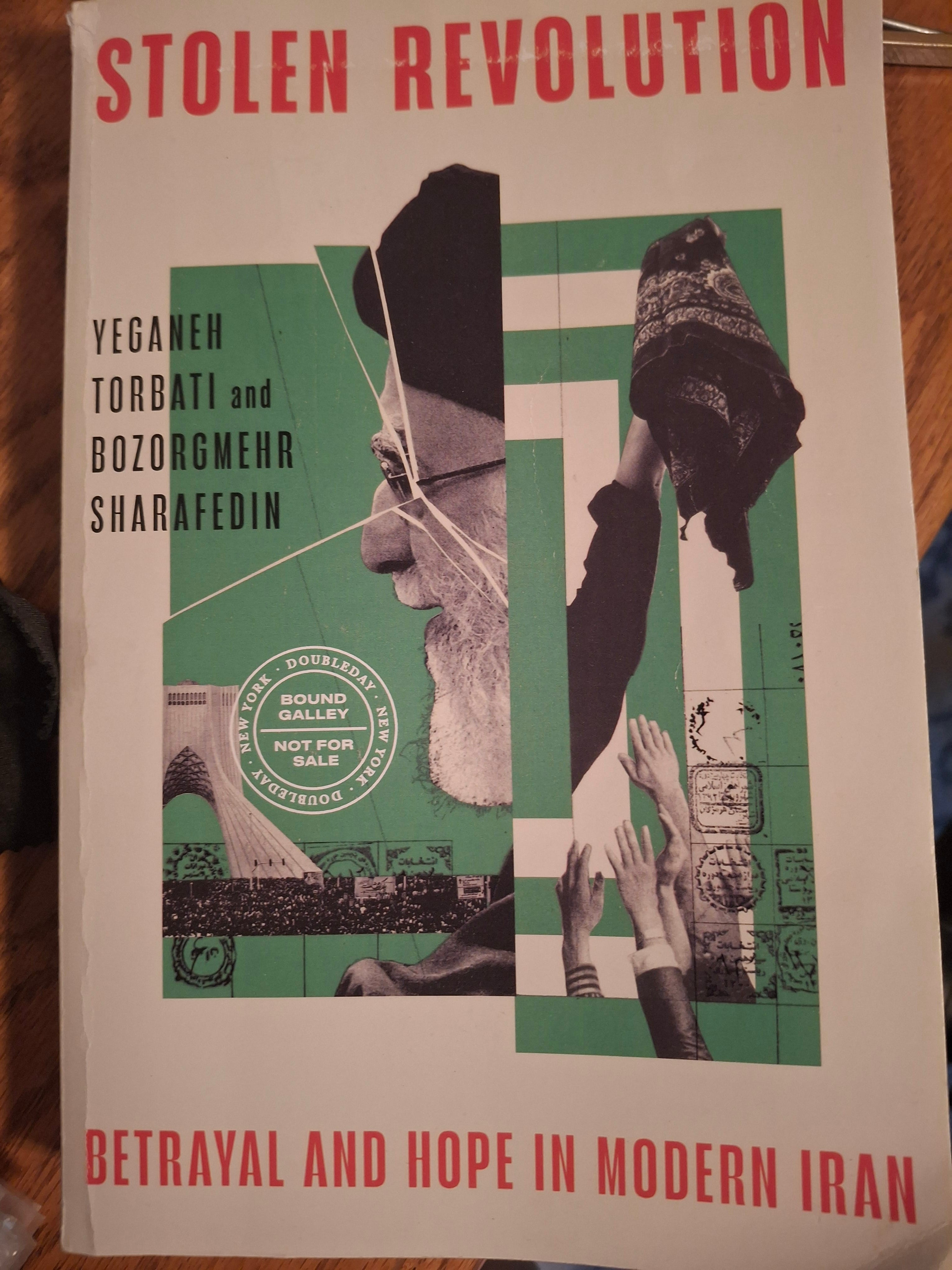
Recently, I read an advance copy of “Stolen Revolution: Betrayal and Hope in Modern Iran,” by journalists Yeganeh Torbati and Bozorgmehr Sharafedin. The book will be released on June 2. You should read it because afterwards you will know more than any of the dopes in the Trump administration about post-1979 revolutionary Iran.
Let us step back from Operation Total Epic Failure and return, prior to this illegal and costly war, to why Iranians were in the streets protesting their repressive government led by brutal, misogynist clerics.
Tens of thousands of brave and desperate Iranians have been killed or been disappeared since taking to the streets to protest an iron-fisted theocracy. Iran’s economy is in free-fall, basic freedoms do not exist and Tehran is running out of water. In one never-to-be fulfilled promise on January 13th of this year, President Trump assured the protestors that “HELP IS ON ITS WAY.”
Well, I guess what he meant by HELP was that a month later the United States and Israel would bomb the living hell out of Iran (and Lebanon) without regard for civilian casualties. This includes the first day of bombing a girls’ school in Minab, Hormozgan Province, where 168 girls were killed, ages 7-12.
“We fight to win, and we don’t waste time or lives…We are warriors, trained to kill the enemy and break their will.”
—Pistol Pete Hegseth, Secretary of Death and Horrible Human
The other brilliant “idea” that Trump and his confederacy of dunces had was that when the bombing commenced Iranian citizens (unarmed) would rise up and overthrow the government. But when you murder innocent girls and more civilians that we will ever hear about, a nation unites against a foreign invasion. The enemy is no longer your own government. (Headline from the NYT on May 14, 2026: “Top Commander Dismisses Reports of Civilian Deaths in Iran.” Dismisses is shorthand for “lies about.”)
Believe it or not, one can hold two ideas at once: to condemn the illegal war Trump started that has led to death and destruction abroad, and higher costs of living at home, and to support of the courageous Iranians who have suffered mightily under a brutal regime.
From “A Stolen Revolution”: “People cut their meat consumption. Women stopped going to the salon, or requested their stylists us cheaper…products. Trips abroad became a distant memory. The poor suffered far worse. It used to be that trash pickers waited for pedestrians to pass before they dove into the large steel buns at the side of the road in search of recyclables to sell. Now they did so with little concern as to who saw them…There were more child laborers, and they looked younger.”
But to expect this U.S. President to care about the suffering of citizens in other countries is a fantasy rooted in magical thinking. After all, he doesn’t even care about Americans’ financial woes. In his own words: “I don’t think about Americans’ financial situation. I don’t think about anybody.”
Fact check: not true. Trump thinks a lot about himself.
A couple of years ago at The Globe Post I wrote an essay about the quest for freedom among Iranian women. I am posting it here. But first I want to quote another passage from “A Stolen Revolution.”
“After four decades of brain drain, the banishment of capable experts from the halls of power, and the promotion of insiders and loyalists…These were no evil geniuses or crafty statesmen. They were incompetent, insular ideologues and sycophants.”
Hmm, does that sound familiar?
Here is the essay:
Imagining a Free Iran
In the early 1980s, in the unlikely setting of a northern Idaho college town, I befriended two Iranian young women, A and M. (I have disguised their names because the reach and memory of repressive countries last forever.)
Before Mohammad Reza Pahlavi, the last shah of Iran was overthrown in 1979, A and M had escaped the Shah’s cruel tenure and his malicious secret police known as SAVAK to begin a new life in the United States. Their parents’ whereabouts were unknown.
Over a platter of fresh fruit and dates, the women, who were attending the University of Idaho, where I was also a student, were pointing at pictures of their friends in a Tehran high school yearbook.
A: “She is dead. She is missing. Her parents were tortured and killed.”
M: “I think she is still in Evin [Iranian’s infamous prison], but no one knows. She was my cousin.”
Fifteen years later, I befriended another Iranian student, T. She and her sister had also fled Iran, via Switzerland, not to elude the grasp of SAVAK and the Shah, but, instead, to escape the demeaning misogyny of Iran, specifically the Revolutionary Guard and the “morality police.”
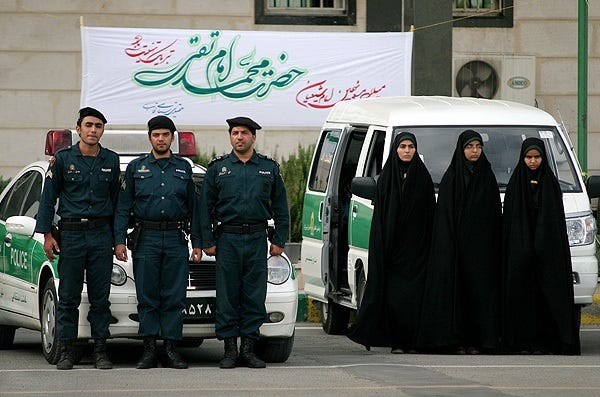
Iranian Guidance Patrol. Farsnews.com
By then, the 1979 revolution’s dream of a more free and open society had been dashed when the Ayatollah Khomeini returned to Iran from his exile in France and became the country’s first Supreme Leader for life. Instead of a more secular government that the majority of Iranians had wanted, one with fair elections, just courts and more freedoms for women, Khomeini instituted an Islamic theocracy that lives on long past his death in 1989.
Currently that legacy is being fiercely challenged by young women seeking freedom not unlike A, M and T. And those widespread protests, the likes that have not been seen in since the 1979 revolution against the Shah, are being brutally put down by the clerics and their thugs.
The accelerant was the death of 22-year-old Mahsa Amini, who the morality police detained for her “improper” wearing of the hijab. How she died in custody remains a mystery, but given the regime’s unchecked and Gestapo-like reputation for arbitrary viciousness, it appears obvious that she was likely tortured and killed.
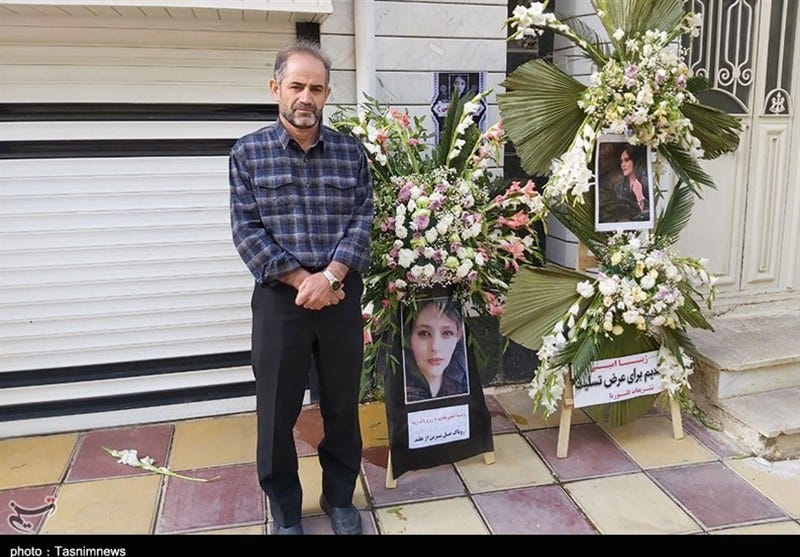
Amjad Amini, Mahsa Amini's father. Tasnim News Agency
The burning of hijabs on the streets of Iran is just one means of resistance among the courageous protestors. Recently a government television was hacked for ten seconds with the words, “the blood of our youths is on your hands.” The pictures of four women killed by Iranian security forces were displayed along with the Supreme Leader’s face in crosshairs.
But demonstrators’ rocks and fires, cyber hacks and anti-government chants are no match for bullets. According to Amnesty International some 134 protestors were killed. As The New York Times reported, in Zahedan, in the ethnic Baluch region of Iran, on September 30 as Friday prayer was ending at the Great Mosalla mosque, government snipers, police officers and possibly members of the Islamic Revolutionary Guards Corps (who have denied involvement) opened fire killing 66 to 96 worshipers.
Here is one eyewitness’ description of what residents now call “Bloody Friday” from the Times: “’It was a massacre I had only seen in movies,’ said Jamshid, 28, a worshiper, who was reached by phone and identified himself only by his first name to avoid reprisals. ‘They started shooting as people still had their heads bowed in prayer.’ Young men threw themselves in front of children and older people to shield them from the bullets, Jamshid said. ‘People had nowhere to go.’”
Then came the lies from the government that bad outside agitators had come into Zahedan “with the aim of turning the protests into violence, chaos and a massacre of innocent civilians and police forces.” This is the usual balderdash served up by repressive regimes.
The truth is that people not only in Iran, but around the world—from Hong Kong to Tibet to North Korea to Russia—long for the freedoms that we in the West enjoy (for now anyway) and take for granted. When citizens express that desire through Arab Spring-style sit-ins or through guerilla-style tactics, they are putting their lives on the line against more powerful autocratic and theocratic forces. Still, the seeds germinate.
Repression kills imagination and stunts creativity. Doors close on possibilities as your world shrinks to a geography of fear. But a government can never really kill ideas, or muzzle individual craving. The embers never die.
In Iran, one such craving is simply for a woman not to wear the hijab if she so wishes. Not to be married off at the age of nine. Not to be rounded up and take to clinics for humiliating virginity checks. Not to have the morality police wipe away makeup with razorblade embedded in a handkerchief.
Long ago I lost touch with my Iranian friends. But I remember them today, as I watch a younger generation of Iranian girls and women continue to fight to enjoy the simple pleasure of feeling the wind in their hair and sunlight on their skin without the threat of being detained and possibly murdered. And to finally imagine themselves as they truly wish to be: Free to dream of a future.
END